
Wendy Lange · 3 November 2026
Strategies for Managing Offline Data Integrity in Portable Observation Platforms
Portable observation platforms collect critical measurements in environments where network connectivity remains unavailable for extended periods, and maintaining data integrity during those intervals requires structured approaches that combine verification protocols with hardware-level safeguards. Researchers at institutions focused on environmental monitoring have documented how field teams rely on these devices for everything from wildlife tracking to geological surveys, where even minor corruption can invalidate entire datasets upon reconnection.
Core Challenges in Disconnected Environments
Power fluctuations, temperature extremes, and physical jostling introduce risks that standard online systems rarely encounter, and studies from government agencies in North America show error rates rising sharply when storage media operate without constant error-correction feedback. Data often moves through multiple stages on a single device before any external validation occurs, creating windows where undetected alterations can persist undetected.
Observers note that portable units frequently switch between low-power sleep modes and active recording, and each transition can interrupt write operations if firmware lacks proper journaling. In regions with extreme seasonal conditions, such as parts of Canada during winter deployments, condensation inside enclosures has been linked to bit-level corruption according to reports compiled by national research councils.
Verification Techniques That Operate Offline
Checksum algorithms embedded at the point of capture provide the first layer of protection, and implementations using cyclic redundancy checks or cryptographic hashes allow devices to flag inconsistencies immediately after each recording cycle. Teams deploying these methods in Australia have reported successful detection of storage failures during multi-day treks without any network access, because the verification runs locally on the platform itself.
Versioning structures further strengthen integrity by maintaining incremental snapshots rather than overwriting previous states, and this approach proves especially useful when sensors generate high-frequency streams. Field documentation from European space agency projects demonstrates how timestamped blocks enable reconstruction even if one segment becomes unreadable, reducing the need for complete re-collection once connectivity returns.
Hardware and Firmware Safeguards
Industrial-grade storage components rated for wide temperature ranges and vibration resistance form the foundation for reliable operation, while firmware-level write protection prevents accidental overwrites during power interruptions. Data from the National Institute of Standards and Technology highlights how self-monitoring drives can report impending sector failures before they affect stored observations, allowing proactive migration of critical files to secondary partitions within the same device.
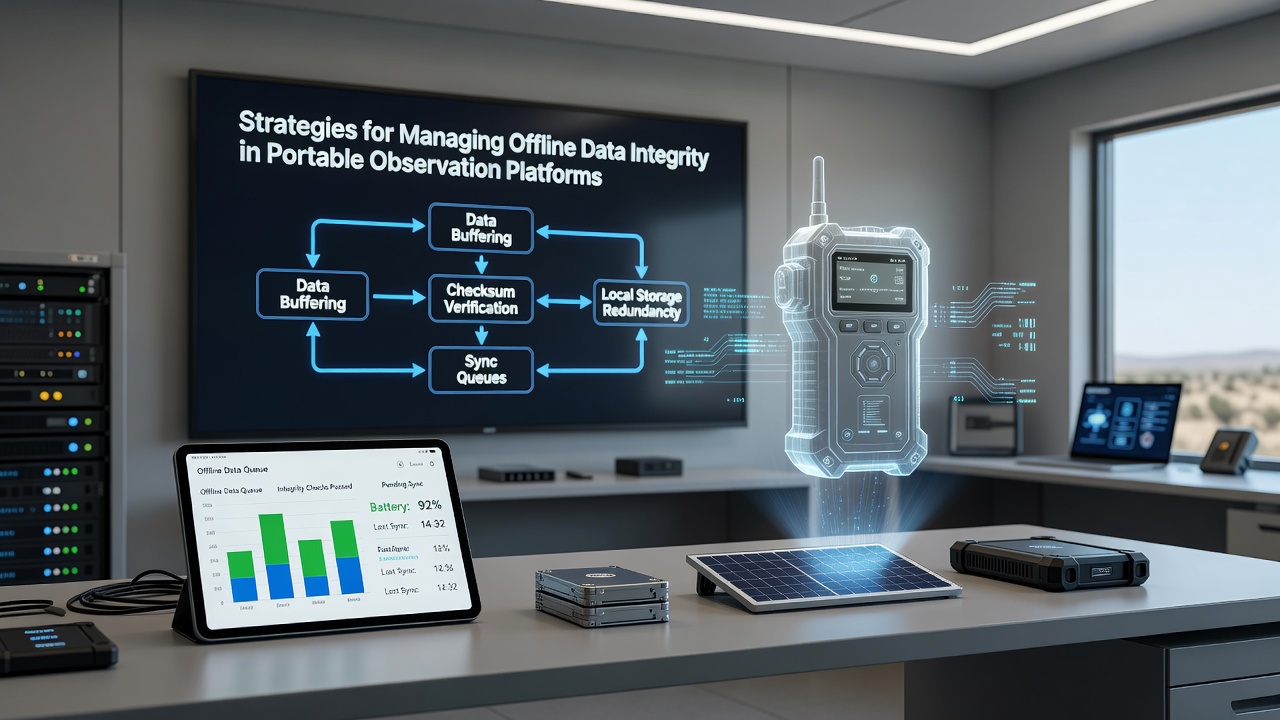
Redundant array configurations adapted for single-device use, such as mirrored internal drives, add another buffer against localized failures, and portable systems designed for November 2026 field seasons incorporate these features as standard components following updated procurement guidelines issued by defense research laboratories. Battery-backed caches ensure that in-flight writes complete even during sudden shutdowns, preserving the last few seconds of sensor input that would otherwise be lost.
Post-Connection Reconciliation Processes
Once platforms regain network access, automated reconciliation routines compare local hashes against reference copies stored on central servers, and discrepancies trigger targeted retransmission of only the affected blocks rather than entire files. Programs run by geological surveys in South America have used this selective approach to cut bandwidth usage significantly during brief satellite windows, according to operational summaries released by those agencies.
Conflict detection algorithms examine metadata timestamps and sequence numbers to resolve any parallel modifications that might have occurred across multiple disconnected units, and integration with established data management frameworks ensures that human review occurs only for genuinely ambiguous cases. This method maintains audit trails that regulatory bodies in multiple jurisdictions require for scientific datasets destined for public archives.
Training and Procedural Supports
Operators receive instruction on recognizing early signs of storage degradation through built-in diagnostic interfaces, and standardized checklists require verification of hash integrity before devices leave controlled facilities. Programs developed by university-affiliated field stations emphasize repeated practice with simulated corruption scenarios so that responses become automatic during actual deployments.
Regular firmware updates delivered through secure physical media keep verification routines current with emerging threat models, and documentation from collaborative projects across Asia-Pacific research networks shows measurable reductions in post-mission data loss after such protocols were adopted systematically.
Conclusion
Effective management of offline data integrity in portable observation platforms rests on layered verification, resilient hardware choices, and disciplined post-connection procedures that together minimize loss even under demanding field conditions. As deployments scheduled around November 2026 incorporate newer self-diagnostic capabilities, the emphasis continues to shift toward proactive detection rather than reactive recovery, supported by standards from organizations such as the National Institute of Standards and Technology and comparable bodies in other regions. These combined measures allow collected observations to retain their value from the moment of capture through eventual integration into larger analytical systems.